This page shows variations of the Medlicott coat of arms. Further discussion of the coat of arms is given in Section X of the Henry Edmondstone Medlicott account.
The Family of Medlicott features two images of Coat of Arms taken from Burke’s Landed Gentry .

The first crest, taken from the 1900 Centenary addition is the coat of arms associated with the Dunmurry branch of the Medlicott family and has the motto “Dat cura quietem”. Henry Edmondstone Medlicott had assumed that the words are taken from Virgil’s IV AEneid, line 5. The full passage in Virgil is “nec placidam membris dat cura quietem”, and Henry Edmondstone Medlicott had translated this as “From real work comes weariness and from weariness comes rest”. Alternatively, one can look at a literal translation of the actual words of the motto which is “Gives – Care/Attention – Calm/Tranquillity”. The Motto would have been originally intended as a war cry or slogan and the version suggested in the “House of Names” website for Medlicott, is “Vigilance ensures Tranquillity”. This seems more in keeping with a war cry or slogan.

The second crest is the coat of arms associated with the hamlet of Medlicott in Shropshire and has the motto: “Crescit vulnere virtus”. William Medlicott had interpreted this as meaning “Virtue flourishes from its wounds”.
Wentnor church, which is the local church for the Medlicott hamlet, contains several hatchments bearing the Medlicott coat of arms. One is fairly large as shown in the first picture below. Notice that the motto is the same as that shown in Burke’s for the Medlicott hamlet.
The bottom right picture shows the crest that can be found on one of the gravestones


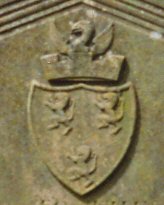

It is of interest to compare the Dunmurry crest with the coat of arms displayed on the outside of the Medlicott vault at Kildare cathedral in Ireland, shown on the home page. The helmet is the same style as the Medlicott hamlet crest rather than the Dunmurry crest, which would have been produced later. The left hand side of the shield shows the three lions which are shown in both of the shields above. The right hand side of the shield features three birds and chevron from his wife’s family (Bagotrath Bagot Coat of Arms see http://baggetthistory.com/irish_data.html and http://baggetthistory.com/bagotrath.html#B. This is indicative of the influence of the Bagot family on George Medlicott, either directly through the marriage with Elizabeth or indirectly as a consequence of her father Edward Bagot who was High Sheriff of Kildare in 1677 and of Kings Co. in 1680.

It is of interest to compare the Medlicott of Dunmurry Coat of Arms with that adopted by Sir William Medlycott of Ven House and that displayed on the Medlicott family burial vault at Kildare Cathedral. The Medlycott crest is taken from the cover of a book, which was a collection of Ovid’s poems printed in London in 1722, owned by Sir William Coles Medlycott, 1st Baronet (1767–1835) of Ven House dated 1780 (provided to me by Paul Anokhin). This has the same Motto as that for Medlicott of Dunmurry. In both cases the orientation of the helmet is side on, like that shown for the Medlicott of Medlicott Coat of Arms in the Medlicott of Medlicott second crest shown above. This suggests that the orientation of the helmet given in the Centenary edition of Burke’s Landed Gentry in 1900 for Medlicott of Dunmurry, may not be quite right. The fact that both the Ven House and Dunmurry Coat of Arms have the same Motto, but different to the one at Wentnor, indicates that there must have been a common ancestor who first established it in his Coat of Arms. The first common ancestor would have been Richard Medlicott of Pontesbury who died in 1603.
It is not known when the Ven House and Rocketts Castle branches of the family adopted the Medlycott spelling instead of Medlicott. Thomas Medlicott of Abingdon is referred to in the records as both Medlicott and Medlycott.